Look past the finish to the pan assortment
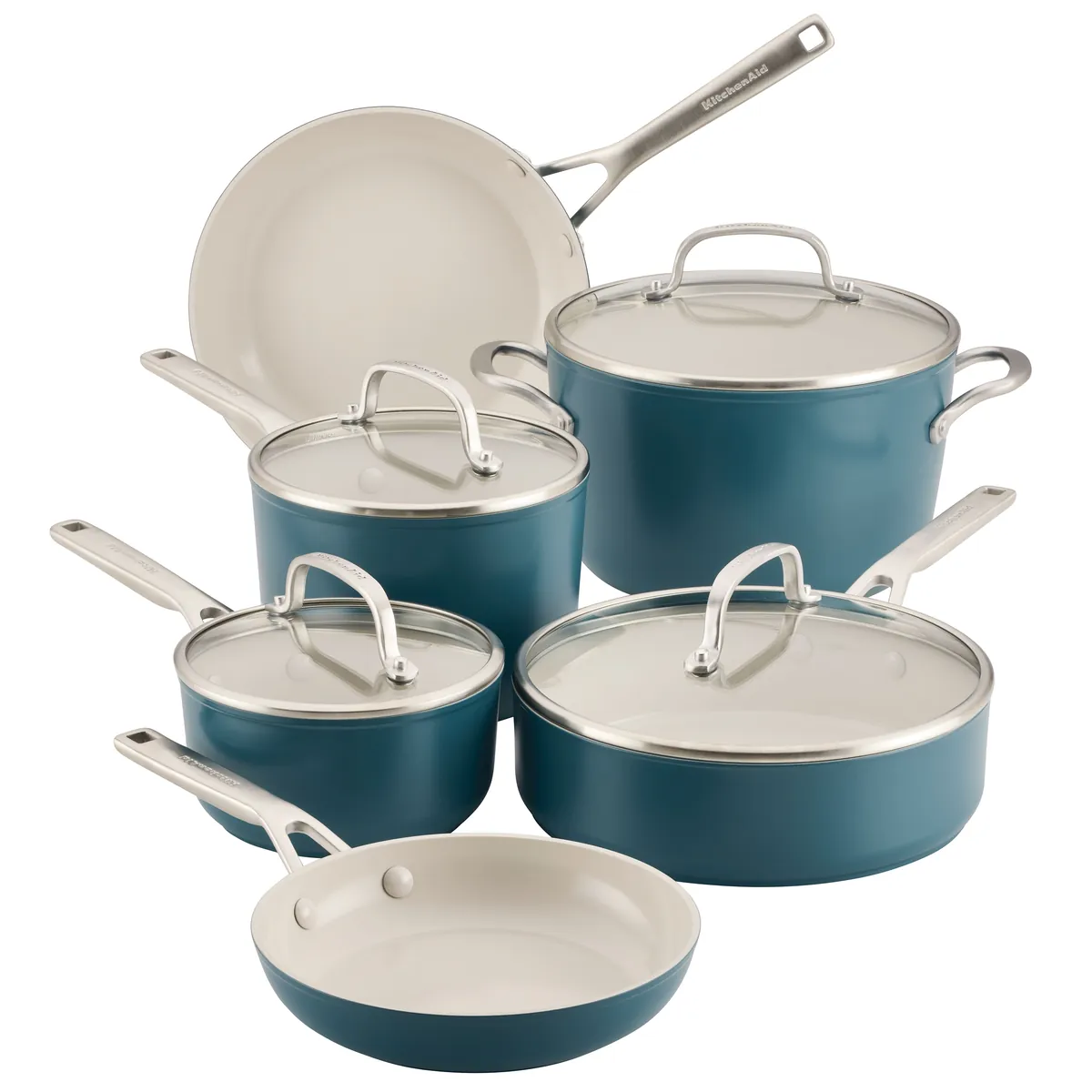
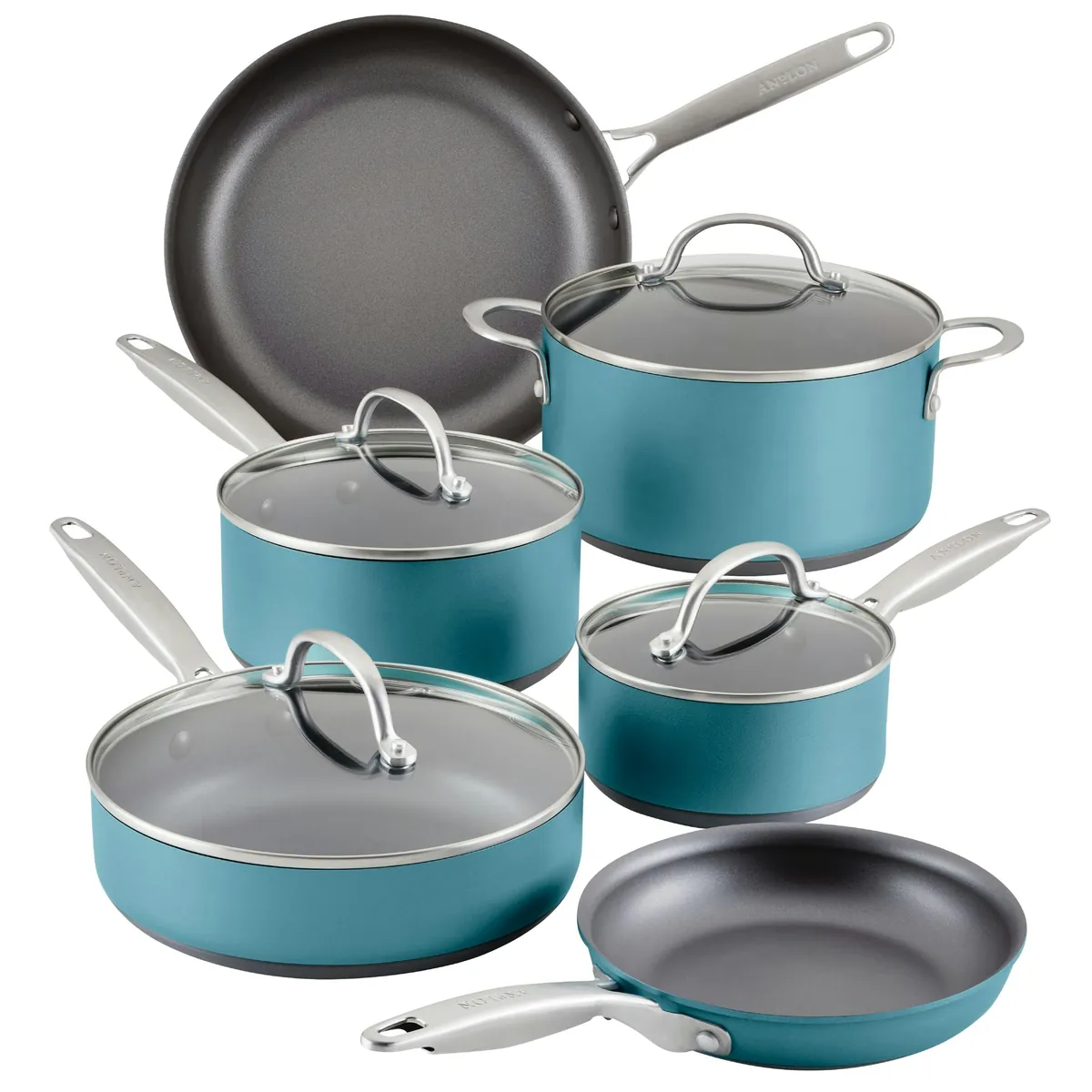
The sizes give this collection a particular character. It can make sense for a cook who boils pasta, simmers soup, and builds a meal in a broad covered sauté pan. It may still leave room in the kitchen for a larger open frying pan. Read the list against the meals you make rather than assuming ten pieces means every cooking shape is represented.
The 5-quart sauté pan deserves the closest look
The covered sauté pan is the piece to consider if you regularly need room for a sauce and its ingredients together. Its 5-quart capacity puts it in a different role from a little skillet used for one egg or a handful of toasted nuts. The helper handle is useful to identify before buying because a filled pan needs a sensible lifting plan, especially when moving between the stovetop, oven, and table.
Capacity does not establish the dimensions of the flat cooking surface. Before treating it as a substitute for a large skillet, check its footprint and compare it with your burner layout. Think through the full meal: how much surface is needed for the initial browning, how much liquid follows, and whether the food must be turned without spilling. A roomy sauté pan can combine those jobs when its shape fits the recipe.
An 8-quart stockpot earns its space with larger batches
The stockpot is large enough to be a meaningful part of the purchase rather than a token extra. An 8-quart vessel gives more working space than the smaller pots in many starter collections. A household making soup for several meals or boiling pasta regularly may appreciate that headroom. Leave adequate space above the contents and follow the recipe's guidance rather than planning to fill a pot to its advertised capacity.
The larger pot also asks for a practical storage and washing arrangement. Consider the sink, faucet clearance, shelf height, and route from the stove to the draining area. A generous pot that you avoid lifting or washing is not automatically an upgrade. If you normally cook a small quantity, keep a smaller saucepan accessible so you do not need to retrieve the stockpot for every task.
The product in this review
The details that matter
Compare the exact model, dimensions, and care instructions before ordering. These notes draw on published specifications.
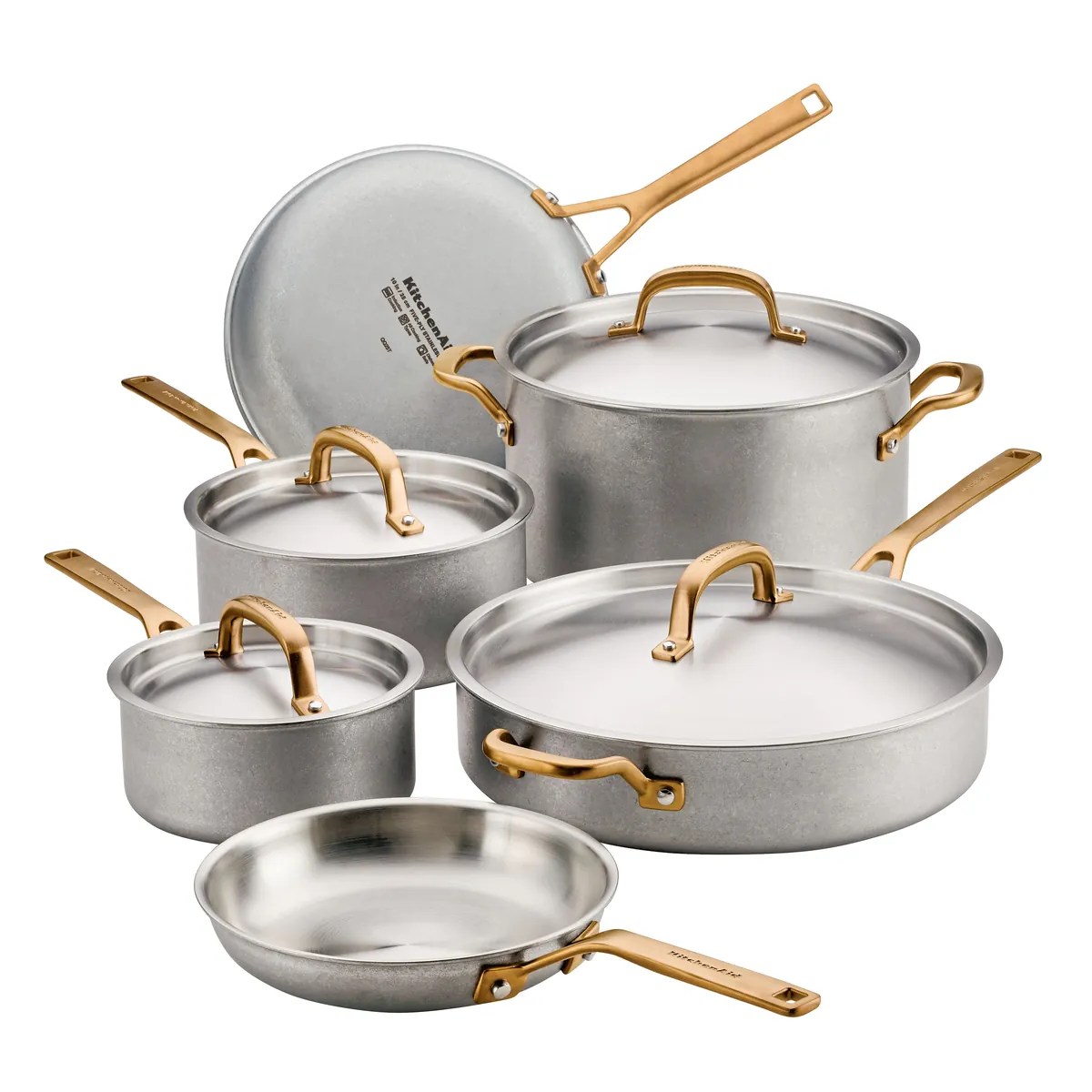
An uncoated stainless set with a large saute pan
KitchenAid Stonewash Stainless Steel 5-Ply Clad 10-Piece Cookware Set
Stonewash 30106 suits cooks who want an uncoated steel collection with a substantial 5-quart sauté pan and 8-quart stockpot. Its smaller frying pans are useful for ordinary portions, but a busy household may still need a larger open skillet. Treat the textured exterior and bronze-tone handles as design preferences, then make the purchase depend on the assortment, storage, and cooking methods you will use.
Read specificationsSize, care, and tradeoffs
- material
- 5-ply clad stainless steel
- finish
- Stonewash-inspired blasted stainless steel exterior; brushed interior with measurement marks
- handles
- Bronze-tone, dual-riveted cast stainless steel
- lids
- Stainless steel
- pieces
- 10: six vessels and four lids
- contents
- 1.5- and 3-quart saucepans with lids; 8-quart stockpot with lid; 5-quart saute pan with lid and helper handle; 8.25- and 10-inch open frying pans
- cooktops
- Induction suitable
- oven
- 500F maximum
- care
- Dishwasher safe
Consider: An 8-quart stockpot and 5-quart saute pan need substantial storage space
Published manufacturer specifications checked 2026-10-15. Read the full specifications and care instructions for the exact model before choosing.
Useful alongside these products
A separately sold pair of silicone-head tongs is a useful companion for turning food in the included frying pans.
Tossing pasta and turning food with silicone heads
OXO Good Grips 12-inch Silicone-head Tongs
Check on AmazonSize, care, and tradeoffs
- material
- Stainless steel with silicone heads
- length
- 12 inches nominal
- storage
- Locking closed
- care
- Dishwasher safe
Consider: Do not leave the tool resting against a hot pan or open flame
Manufacturer specifications ↗Product identity checked 2026-10-14. Check the Amazon listing for the exact model, seller, and current availability.
The two frying pans cover smaller everyday work
The included 8.25- and 10-inch frying pans make sense for separate portions, a small side, or a short stovetop task. They are less persuasive as the only open skillets for a household that often cooks several large pieces of food at once. A set can have a large stockpot and still be short on the exact open-pan surface you use most.
Nominal diameter also does not tell you the size of the flat base inside a frying pan. Sloping sides take up some of that space. If your usual dinner already crowds a 10-inch skillet, buying a coordinated 10-inch skillet will not create more room. Plan to keep or add a larger frying pan when the recipe calls for it, and let the included smaller pieces serve their own useful jobs.
Five layers describe construction, not a cooking result
Meyer describes three aluminum layers bonded between two stainless steel layers, with the clad construction extending from the base to the rim. The point of examining that specification is to understand the body you are buying. It does not by itself establish that five layers will outperform every three-layer pan in your kitchen. Geometry, thickness, the burner, and the amount of food still matter in use.
The cooking surface is stainless steel rather than a ceramic or traditional nonstick coating. That makes this a different purchase from KitchenAid's Agave ceramic set. Approach food release through heat control, appropriate fat, and the cooking method. For a pan sauce, the browned residue can be part of the process. For a particularly delicate breakfast, you may prefer to keep a separate coated pan instead of expecting one material to suit every task equally.
Stonewash is a finish choice with a clear visual purpose
The collection pairs a textured, muted steel exterior with bronze-tone cast stainless steel handles. Its appeal is easy to understand in a kitchen where bright polished metal feels visually stark. Choose the finish because you enjoy looking at it and because the actual vessels fit your cooking. It should not be treated as evidence of easier food release or a different recipe temperature.
The stainless steel lids are another practical distinction. They cover the food without offering the view through a glass lid, so you will lift them when you need to inspect the contents directly. Have somewhere stable to rest a hot lid. Coordinated metal lids can look tidy on a shelf, but the useful questions are whether they suit your cooking and whether each one has an accessible storage position.
The everyday details matter more than a maximum rating
The saucepans and stockpot have volume markings, and the collection has flared rims for pouring. Markings can help with a quick visual check while cooking, although a recipe that needs an exact measured amount still deserves a measuring tool. Pour deliberately and keep a clear path to the receiving vessel. Neither a rim shape nor an etched line removes the need to handle a hot pot carefully.
The manufacturer lists induction compatibility and a 500°F oven rating, including the lids. It also lists dishwasher compatibility. Those are useful operating boundaries, with the supplied care instructions remaining the reference for your exact pieces. Before a stovetop-to-oven recipe, consider rack clearance and the landing place for the hot pan as well as temperature. Handles that are easy to grasp at room temperature still need suitable protection after oven use.
Choose the set when the larger vessels will work regularly
Stonewash 30106 is most convincing when you need both the substantial sauté pan and the 8-quart stockpot, want uncoated steel cooking surfaces, and like the quieter exterior finish. The two saucepans give it everyday range, while the smaller frying pans are useful complements. Confirm the 10-piece Stonewash assortment rather than relying on the KitchenAid name alone; other collections and finishes can carry different contents.
If your present pots already do these jobs well, a single larger sauté pan or frying pan could be a more useful addition. If you mainly want easy-release breakfast cookware, start by comparing a coated frying pan. The complete set makes the strongest case when its core sizes match an actual gap in your kitchen. The finish can then be a welcome part of the decision rather than the only reason for buying six vessels at once.
Before you buy
What to look for
Use for the large vessels
The 8-quart stockpot and 5-quart sauté pan are the most distinctive working sizes here. List the meals that would use them before buying the complete set. If both would be occasional extras, compare a smaller assortment or individual replacements that better reflect the pans already in regular rotation.
Steel cooking surface
This is stainless steel cookware, with a cooking approach different from a coated frying pan. Consider whether you enjoy browning ingredients and making pan sauces, and whether a separate delicate-food pan still belongs in your kitchen. Five-ply construction does not establish effortless release for every ingredient.
A workable storage plan
Allow room for six vessels and four metal lids, including the larger stockpot and helper-handled sauté pan. Check the sink and oven as well as the cupboard. An assortment that can be retrieved, washed, and put away easily is more useful than one that forces a shelf rearrangement every evening.
Make the decision
Choose for your kitchen
Cooking soup and saucy dinners for several meals
The stockpot and sauté pan give this set a coherent role for that routine. Check the physical dimensions against your cooktop and storage, and decide whether the saucepans cover your smaller tasks. Keep enough open-pan surface for any browning stage that precedes the larger batch.
Replacing a coated cookware collection
Expect a change in technique rather than the same cooking surface in a different color. Steel can suit browning and deglazing, but it will not behave like ceramic nonstick. Keeping one suitable coated pan for eggs or other delicate foods may make the transition more practical.
Refreshing a kitchen for its appearance
The Stonewash finish and warm-toned handles can be a legitimate preference, especially when cookware is visible on open shelves. First make sure the six vessels will be used. If your existing collection already fits your meals, an individual piece may offer a smaller and more useful change.
A few useful answers
Questions before you buy
How many pots and pans are included?
The 10-piece count comprises six vessels and four lids: two saucepans, a stockpot, a sauté pan, and two frying pans. The stockpot is 8 quarts and the sauté pan is 5 quarts. Lids are included with the two saucepans and both larger covered vessels.
Is the cooking surface nonstick?
The specified interior is brushed stainless steel, not a ceramic nonstick surface. Manage heat, fat, and cooking technique accordingly. If a coated pan is central to your breakfast routine, do not assume the Stonewash finish changes the release behavior of the stainless steel interior.
Can Stonewash 30106 be used on induction and in the oven?
The manufacturer lists the collection as suitable for induction and oven safe to 500°F, including its stainless steel lids. Follow the supplied instructions for the exact pieces, and check that the pan, handles, and lid fit comfortably in the oven arrangement required by the recipe.
Are the handles solid bronze?
The product specification identifies cast stainless steel handles, while the collection uses a bronze-toned appearance. The finish should not be confused with a solid bronze handle material. Choose the styling if you like it, and use appropriate hand protection when the handles have been heated in the oven.