Buy the knife your hand can control
A familiar recommendation cannot answer the grip question for everyone. Hand size, cutting style, board space and comfort all matter. Choose the Fibrox because its practical dimensions and handle suit your preparation routine, rather than expecting the name alone to make a knife comfortable or eliminate the need to maintain a sharp edge.
Read the blade size against the cutting board
The manufacturer gives a 7.9-inch blade, commonly described as 8 inches. That length is useful for many ordinary ingredients, but it needs room to work. A narrow board surrounded by bowls can make an otherwise sensible chef knife feel unnecessarily awkward.
Check the whole preparation area before ordering. You need clear room for the ingredient, the path of the blade and the pieces after cutting. A larger board or better organization may improve daily preparation more than changing knives. If your kitchen only permits a very compact workspace, consider whether a smaller blade better fits the actual movements you can make comfortably.
The broad blade serves more than appearance
The extra-wide profile is part of this exact model’s identity. It creates a different shape from a narrow slicing knife, and the straight edge supports a general preparation role. Evaluate it around the vegetables, herbs and proteins you ordinarily cut instead of treating every chef knife outline as interchangeable.
A broad blade can also make the area between your grip and board feel different from a slim knife you already own. Inspect that relationship if possible. Comfort depends on more than the number printed as blade length. The profile, handle position and way you move through a cut should work together without forcing an unfamiliar grip that never becomes pleasant.
The product in this review
The details that matter
Compare the exact model, dimensions, and care instructions before ordering. These notes draw on published specifications.
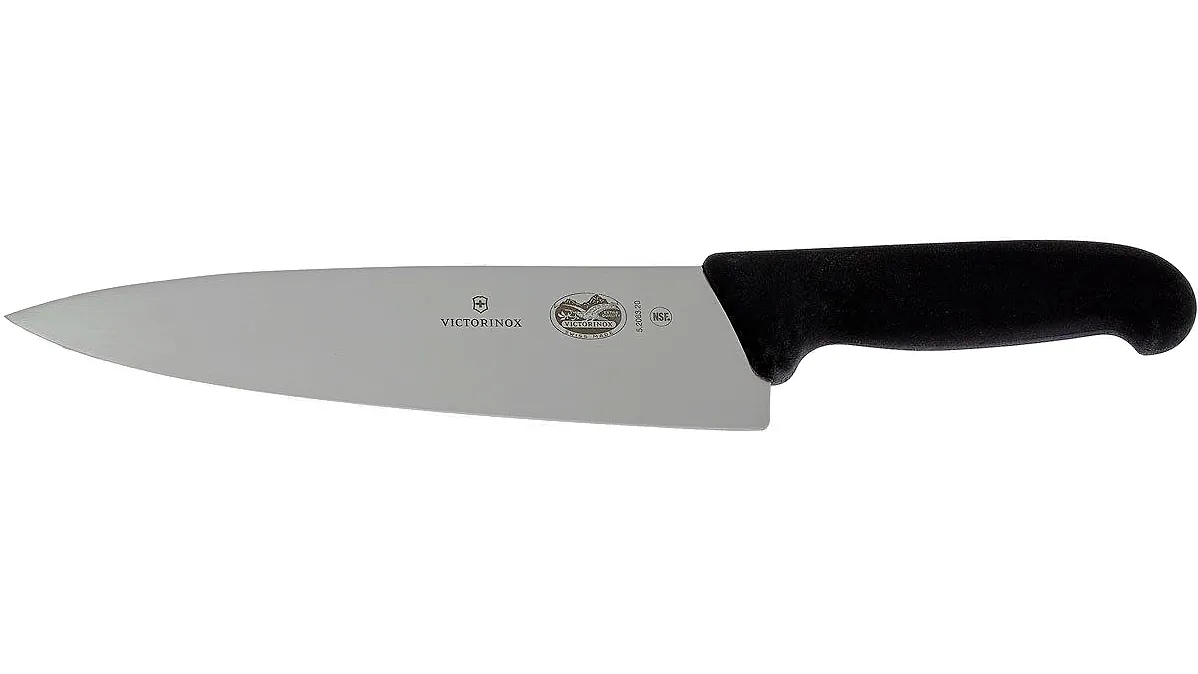
A primary knife for ordinary prep
Victorinox Fibrox Pro 8-inch Chef Knife
The Fibrox 5.2063.20 is a useful everyday chef-knife candidate when its roughly 8-inch blade and wide profile fit your board and grip. Prioritize handle comfort and a sharpening plan. A familiar model name cannot replace those practical checks or make one knife ideal for every hand.
Check on AmazonSize, care, and tradeoffs
- blade
- Approximately 8 inches; straight edge
- construction
- Not forged
- handle
- Thermoplastic elastomer
- origin
- Switzerland
Consider: Handle comfort needs a personal grip check
Manufacturer specifications ↗Research based on manufacturer specifications and product identity checked 2026-10-14. Price, seller, and availability can change; review the Amazon listing.
Compare your options
Victorinox Fibrox vs. Mercer Millennia Chef Knives ↗Check the handle with the grip you actually use
Victorinox identifies a thermoplastic-elastomer handle and describes a textured, non-slip design. Those details are useful, but they cannot establish perfect control under every condition. Inspect the shape with the grip you intend to use, and consider how the handle meets the blade rather than judging only its appearance.
If you can try the knife before committing, make the comparison deliberate. Hold it as you would during normal preparation and consider the workspace it will use. Do not assume a handle that feels substantial in one person’s hand will suit another. A good fit makes regular cooking easier without needing a claim that one design is universally ergonomic.
Non-forged construction is a fact, not a verdict
The official specifications say this model is not forged. That identifies its construction without establishing that it is inferior or superior to every forged alternative. For a home cook, useful questions remain grip comfort, blade size, appropriate maintenance and how well the knife matches ordinary ingredients.
Avoid building the purchase around labels that do not solve a specific problem. A heavier or more elaborate-looking knife is not automatically more comfortable, and a plain working handle is not automatically less capable. Choose the combination you can use well and maintain, rather than treating construction terminology as a substitute for the practical fit check.
Plan sharpening before the edge becomes a frustration
Everyday usefulness includes a way to maintain the edge. Follow Victorinox’s guidance for sharpening and care, whether that means an appropriate tool you know how to use or a suitable sharpening service. Do not invent an angle or process from another knife merely because both are sold as chef knives.
Pay attention to changes during normal cutting and maintain the edge according to that guidance. A new knife is not a permanent escape from sharpening. If an existing blade mainly needs appropriate maintenance, address that before buying a replacement. A clear care plan can make one useful knife more valuable than several neglected alternatives in a block.
Give the knife a clear washing and storage route
The manufacturer lists dishwasher compatibility for this model. A deliberate wash-and-dry routine can still be convenient because you control where the blade sits and when it returns to storage. Follow current brand care directions and avoid treating the kitchen sink as an unseen holding place for a sharp tool.
Choose storage that keeps the edge protected and the handle easy to reach. A suitable guard, block or other appropriate system should fit the actual knife rather than forcing it into an unsuitable slot. Keeping the preparation area organized through cleanup is part of making a general-purpose chef knife comfortable to live with, not merely something to consider after purchase.
Who should choose this Fibrox?
Choose the 5.2063.20 when you want an approximately 8-inch general preparation knife and the handle and wide profile fit your hand and board. It makes sense as a focused working purchase, especially when it fills a genuine gap instead of joining a large set of rarely used blades.
Choose a different size or shape if your space and grip point elsewhere. Keep an existing knife when maintenance is the only missing step and its basic fit is already right. Product specifications help narrow the options, while the final useful choice belongs to the person who will hold the knife through hundreds of ordinary preparation tasks.
Before you buy
What to look for
A grip that stays comfortable
Evaluate the handle using your ordinary cutting grip, with attention to the junction between handle and blade. Texture and material are useful specifications without guaranteeing universal comfort. If another shape gives better control, choose it rather than forcing yourself to adopt a knife that never feels natural in regular preparation.
Room for the blade to work
Compare the blade length with the actual clear cutting area, not simply the board’s label. Bowls and prepared ingredients can consume space quickly. A general-purpose knife is most useful when the whole preparation setup allows comfortable movements and keeps the next ingredients organized instead of crowding the cutting path.
A realistic maintenance plan
Decide how the edge will be sharpened and where the knife will be stored before buying. Follow the maker’s guidance rather than guessing an angle from another model. A useful blade needs ongoing care, and addressing a neglected existing knife can sometimes solve the same preparation problem without another purchase.
Make the decision
Choose for your kitchen
A primary knife for ordinary prep
The Fibrox has a clear role when slicing, dicing and chopping recur across your meals. Its size and wide profile should fit the ingredients and workspace you actually use. Choose it as one purposeful working tool rather than assuming a large matching knife set is necessary to prepare everyday dinner.
A cook improving the whole prep station
Pair the knife decision with a steady board, clear space and organized ingredients. Those changes can support control as much as the blade choice. A new knife becomes more useful when the station around it permits an orderly method instead of recreating the same crowded setup with a different handle.
A small board or a poor handle fit
Consider another size or design if those are persistent limitations. The popular 8-inch class is not a requirement for every home cook. A knife that suits your hand and space can be a better purchase than a familiar recommendation whose dimensions make ordinary cutting feel awkward or constrained.
A few useful answers
Questions before you buy
Which Fibrox model is reviewed here?
This is the extra-wide chef knife 5.2063.20 with a black handle and approximately 8-inch straight blade. Confirm the exact model before ordering. Another Victorinox knife can share the Fibrox name while differing in blade length, profile or edge type.
Is it forged?
The manufacturer’s specifications say this model is not forged. Treat that as a construction fact rather than a complete quality judgment. Handle fit, workspace, intended cutting tasks and edge maintenance are more useful questions when deciding whether the knife belongs in your kitchen.
Does an 8-inch knife fit every home cook?
No single size fits every hand and board. The official blade measurement is about 7.9 inches, commonly described as 8 inches. Check the clear working area and your normal grip before choosing it, particularly if preparation space is limited.
Can a new knife remove the need for sharpening?
No. Plan appropriate edge maintenance according to the manufacturer’s guidance. If your existing knife fits well but cuts poorly because it needs care, address that first. Buying another blade without a maintenance plan can reproduce the same frustration later.
Keep in mind
Check the selected size, included pieces and care instructions before ordering.